

The role of a university such as the Politècnica de Catalunya (UPC), the definition of its key activity, and the part it plays in the area of innovation are illustrated by a headline that appeared in newspapers a few days ago: “The UPC leads Spanish universities in the ranking for knowledge transfer“.
Universities are organized as knowledge ecosystems composed of specialists in a wide range of fields, who can transmit their knowledge through teaching and research. Companies join this virtuous circle as recipients of the innovations and technological developments that emerge from university research and development centres.
 Collaboration with a university such as the Politècnica de Catalunya, which draws on the experience of its lecturers and researchers to develop solutions that increase business productivity and competitiveness, is an added value for the production sector. It is particularly valuable for companies striving at global level for new products and services, new markets and more efficient responses to activities that generate value: the production of goods and services, their distribution and use.
Companies have made a considerable effort in recent years to increase the visibility of the values of social responsibility that they have adopted. In this process, innovation plays a very important role, because its benefits go beyond the economic. Innovative companies generate more and better quality jobs, contribute to the development of the entire system, and benefit those who, without being innovative themselves, profit from the contact with new technologies and developments. In addition, innovative companies are more resilient to recession, and can return part of the benefit obtained to its origin in the research and development system, which includes universities and technology centres.
This has been the case since economic processes changed two-hundred years ago, during the first industrial revolution. And this is happening now, at a time when the paradigm shift in technology, energy, communication and the environment requires an increasing effort to find solutions to social and business needs. Behind every new challenge are new development opportunities, arising from materials such as graphene, production models such as 3D printing, and the use of new energy sources such as renewable energies.
The speed and intensity of changes is so great that many companies, the vast majority, need partners to carry out operations such as research and development, whose simple description conceals the sometimes unknown effort of researchers and technologists. This task, which is mainly carried out by public entities such as the UPC, contributes directly to the development of the environment.
Universities also play an important role in determining where we are going. They know how to look beyond the everyday, and to make out the next steps; this is another contribution of the university system. We need points of reference to focus on the future in the mid- and long-term. I like to talk of the use of headlights to see where we are going, and here we find a good example in the use and improvement of technologies offered by universities, like LED lights.
We must look further forward, but we must also do this better and more effectively to reduce risks and optimize efforts. We must use technology to see the future.
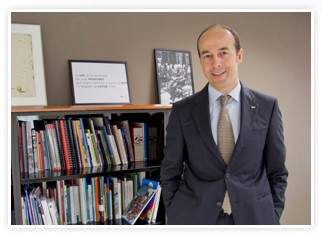
Ramón Carbonell Santacana
President of the UPC Board of Trustees of the UPC
and Vicepresident of CIT UPC